Bitcoin Mining

Caleb Ryan
| 14-05-2026
 · News team
Mining is often simplified as computers solving puzzles, but in practice it is a competitive, resource-heavy system coordinating a global network. In Bitcoin, miners secure the ledger by validating transactions and competing to add new blocks.
This process blends cryptography, economic incentives, and game theory to keep participants honest without central control. The result is a self-regulating system where trust emerges from incentives rather than authority.
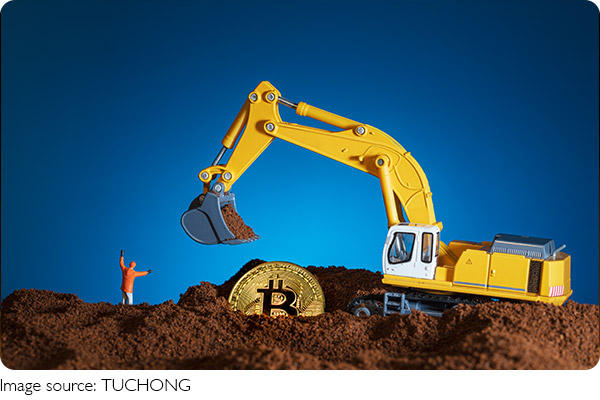
What Mining Actually Does
At its core, mining performs two essential roles: validating transactions and securing the network. Every time someone sends Bitcoin, that transaction is broadcast to a global network of nodes. Miners collect these pending transactions and bundle them into a candidate block.
However, adding that block to the blockchain is not automatic. Miners must prove they have performed computational work—this is known as Proof of Work. The system requires miners to find a specific hash value that meets strict conditions. This process is not about intelligence or strategy; it is brute-force trial and error at massive scale. This mechanism ensures that rewriting transaction history would require enormous computational resources, making fraud economically impractical.
The Competitive Nature of Hashing
Mining operates like a global race. Each miner repeatedly modifies a small piece of data in the block (called a nonce) and runs it through a cryptographic hash function. The goal is to produce a hash that falls below a dynamically adjusted target. Because hash functions are unpredictable, the only way to succeed is through sheer volume of attempts. This is why mining power—measured in hash rate—has become the defining factor in profitability.
The difficulty of this process adjusts roughly every two weeks. If more miners join the network, the system automatically makes the puzzle harder. This keeps block production consistent at about one block every ten minutes, regardless of total network power.
From Home Computers to Industrial Operations
In Bitcoin’s early days, mining could be done using standard CPUs. That quickly evolved into GPU mining, then FPGA setups, and eventually highly specialized ASIC (Application-Specific Integrated Circuit) machines. Today, mining is dominated by industrial-scale operations. These facilities resemble data centers, often located in regions with cheap electricity and favorable climates for cooling.
Efficiency is everything—miners compete on margins, where even small differences in energy cost or hardware performance can determine profitability. This shift has effectively removed casual participants from meaningful competition. While individuals can still mine, they typically join mining pools, combining computational resources with others and sharing rewards proportionally.
The Economics Behind Mining
Mining is not just a technical process—it is an economic system driven by incentives. Each successful miner receives two types of rewards:
- Block subsidy: Newly minted Bitcoin issued with each block
- Transaction fees: Payments from users to prioritize their transactions
The block subsidy is designed to decrease over time through events known as halvings, which occur approximately every four years. As of 2024, the reward stands at 3.125 BTC per block. This gradual reduction enforces scarcity and mimics commodity extraction, where resources become harder to obtain over time.
Eventually, the subsidy will reach zero, and miners will rely entirely on transaction fees. This transition raises ongoing debates about long-term network security and fee market sustainability.
Energy Consumption and Efficiency Debate
One of the most controversial aspects of mining is its energy usage. The Bitcoin network consumes a significant amount of electricity, comparable to that of some small countries. Critics argue this is wasteful, while proponents highlight that energy consumption is what secures the network.
Importantly, not all energy used is equal. A growing portion of mining operations utilize stranded or renewable energy sources—such as hydroelectric surplus or flare gas that would otherwise be wasted. In this sense, mining can act as a buyer of last resort for excess energy, improving overall efficiency in certain energy markets.
Security Through Decentralization
Mining is fundamental to Bitcoin’s security model. Because thousands of independent miners participate globally, no single entity can easily control the network. To successfully attack Bitcoin, one would need to control a majority of the total hash rate—a scenario that is theoretically possible but economically and logistically prohibitive.
This decentralized competition ensures that miners are incentivized to act honestly. Any attempt to cheat the system would likely result in financial loss, as invalid blocks are rejected by the network.
The Long-Term Outlook
Bitcoin’s supply is capped at 21 million coins, with the final fraction expected to be mined around the year 2140. As the issuance rate declines, the network will increasingly depend on transaction fees to sustain miner participation. This evolving structure transforms mining from a subsidy-driven system into a fee-based security market. Whether this model will remain robust decades from now is still a subject of active research and debate among economists and cryptographers.
“Bitcoin mining is the process by which the network achieves decentralized consensus without relying on a central authority,” explains Satoshi Nakamoto in the original Bitcoin: A Peer-to-Peer Electronic Cash System white paper. Nakamoto describes mining as a mechanism where computational power is used to secure the network, verify transactions, and prevent double spending.

Mining is more than a method of creating new coins—it is the backbone of trust in a system that operates without centralized oversight. It aligns incentives, enforces rules, and protects the integrity of the blockchain through measurable economic cost.